
Different models catch different mistakes, and a single reviewer pass tends to miss what its model is weak at. Version 0.26.10 of the Unstoppable desktop app adds a bundled pipeline, Code Review Multi-Provider, that sends one branch to several Claude and Codex reviewers at once, merges what they find into one scored review and posts it to the branch's pull request.
The app already had code review pipelines that ran more than one model. What's new in this release is the way the reviewers are split and checked, a security track, and the result landing on GitHub as a review with inline comments.
Running it
Code Review Multi-Provider is listed with the other Bundled Pipelines on the Pipelines page. It runs on demand, from a worktree. In the activity panel, the Pipeline Runs section has a Dispatch button; choose Code Review Multi-Provider in Dispatch Pipeline and start it.
It reviews the worktree's branch against its base branch, including uncommitted changes unless you turn that off. Each reviewer track can be switched off for a run.
When you dispatch it, the run asks for a few inputs:
- Base branch, the branch to compare against.
- Whether to include uncommitted changes, on by default, so you can review work the agent hasn't committed yet.
- Post PR comment, on by default.
- Optional files from a plan-driven run: a checkpoint that separates earlier changes from the ones under review, a plan scope, a plan contract or a quality assurance (QA) intent summary.
- A switch for each of the seven tracks.
The plan files tell the reviewers what the change was approved to do, so a finding can be checked against the agreed plan instead of a guess about intent.
Seven tracks, one review
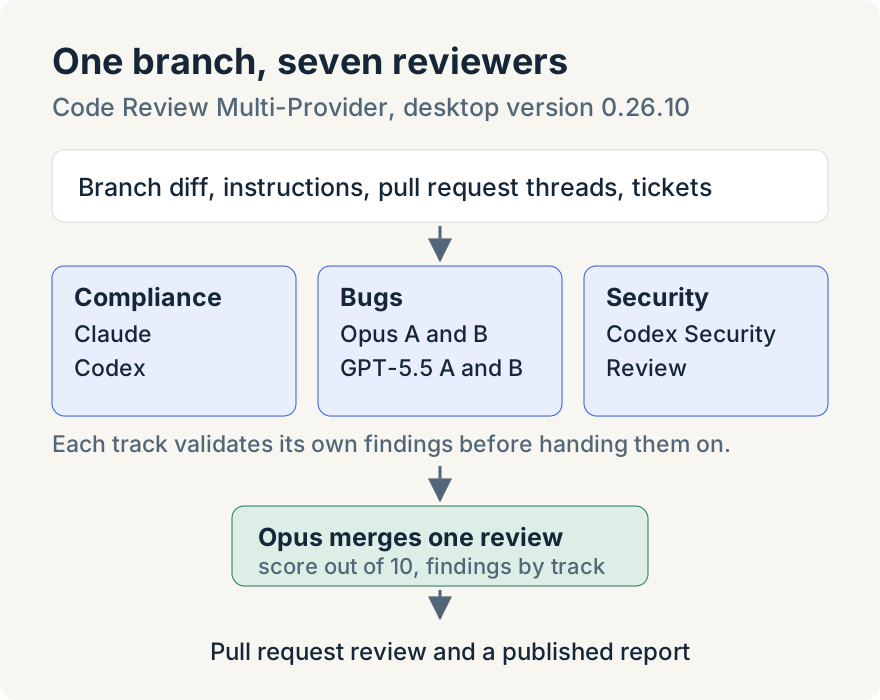
The pipeline gathers context first: what changed, the repository's instruction files, the branch's pull request and its existing review threads, and linked Linear tickets when a Linear application programming interface (API) key is available. The pipeline also writes a summary of the change before the reviewers start. Then seven reviewer tracks run side by side:
- Repo Compliance Review Claude and Repo Compliance Review Codex check the change against the repository's own instructions in
CLAUDE.mdandAGENTS.md, and report only violations of them. - Opus Bug Review A and B, and GPT-5.5 Bug Review A and B, look for bugs: two independent passes on each model.
- Codex Security Review looks for security problems, using OpenAI's Codex security plugin.
Every reviewer is told to report only high-signal issues, and each track checks its own findings before handing them on. A failing track doesn't stop the others. A final step, Synthesize Final Review, runs Opus at its maximum reasoning effort to merge the findings into one review, removing duplicates and noting which tracks reported each issue.
What lands on the pull request
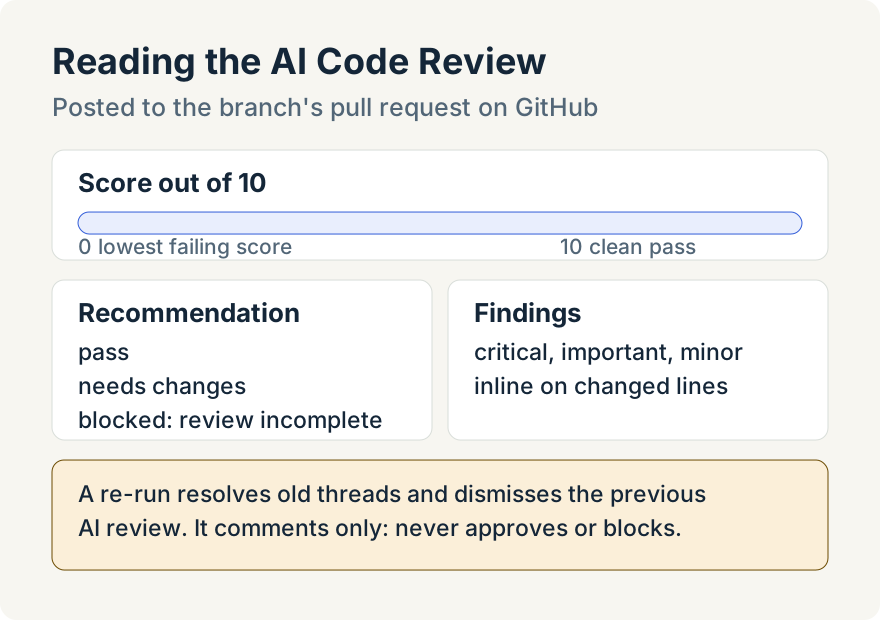
If the branch has an open pull request on GitHub, the review is posted there as a GitHub review. Its summary starts AI Code Review, followed by the attempt number, a score out of 10 and a risk level. A table counts critical, important and minor issues, and sections follow for the summary, the risk assessment and the issues themselves, ending with a recommendation. Each finding that points at changed lines also appears as an inline comment on those lines.
The score is a passing score, not a risk score: 10 means a clean pass with no validated findings, and 0 is the lowest failing score. The recommendation is pass, needs changes when there are findings to act on, or blocked when the review couldn't be completed.
Running the review again on an updated branch doesn't pile up old comments. The pipeline replies to or resolves its earlier comment threads where the findings changed, and dismisses its previous AI review with "Superseded by a newer AI code review." If GitHub refuses an inline comment, for example because the line is no longer in the diff, the finding is posted at file level or in the review body instead, so nothing is dropped.
Post PR comment is on by default. Turn it off and nothing is posted to GitHub. Either way, every run also publishes a Markdown report as part of the run, with the score, the findings, notes on where the tracks agreed and which tracks reported each issue.
Where it stops
- It comments; it doesn't decide. The review is posted as a comment. It never approves a pull request or requests changes, and it doesn't block a merge.
- It needs both providers. The tracks use Claude models (Sonnet and Opus) and GPT-5.5 through Codex, and the security track needs the Codex security plugin. Posting needs the GitHub command-line tool signed in.
- It reviews your local branch. It reviews the worktree's diff and finds the pull request by branch. You can't point it at someone else's pull request by its address.
- It's deliberately quiet. Reviewers are told to report only high-signal issues and to leave out style preferences, nitpicks, pre-existing problems and anything a linter would catch, so a short review isn't proof that nothing could be improved.
- It runs in the desktop app and uses your Claude and Codex accounts for every track.
Tommy Irish built Code Review Multi-Provider and its pull request comments.
Try it
Code Review Multi-Provider is in version 0.26.10 of the Unstoppable desktop app. Download Unstoppable, open a worktree with a branch to review and dispatch it from Pipeline Runs. From version 0.26.11 it's listed as Code Review (Multi-Provider), and current versions call pipelines workflows. The seven-track lineup and named models above describe 0.26.10; later versions changed the reviewer lineup, model selection and security tooling.