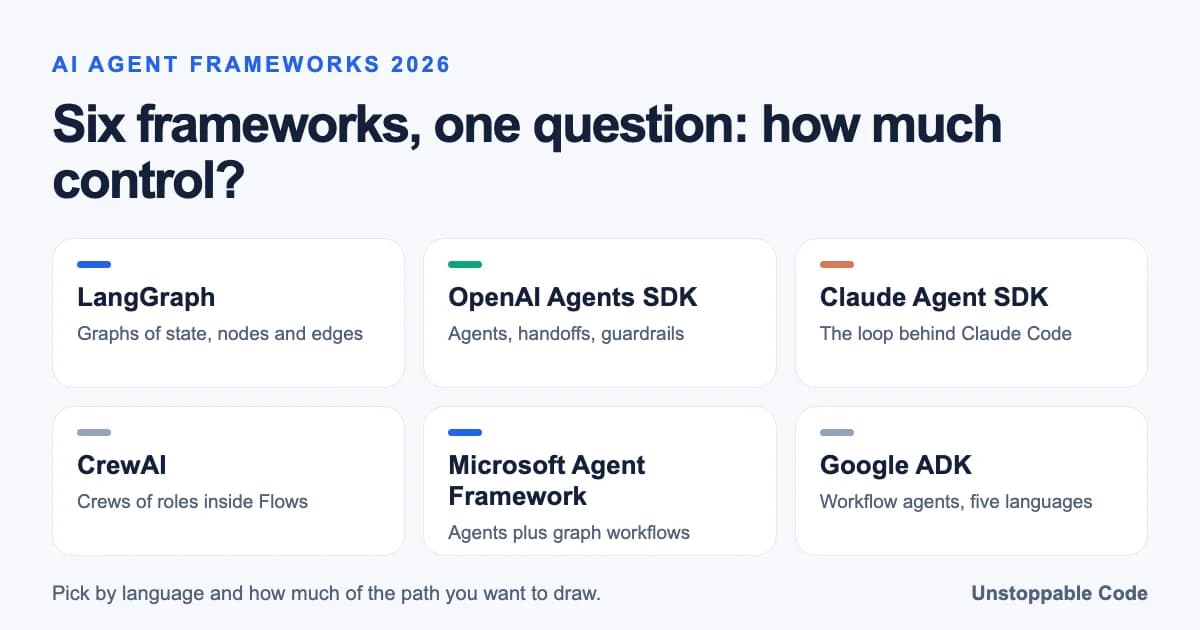

An AI agent framework is a code library that runs the loop behind an agent for you: it calls the model, runs the tools the model asks for, keeps track of state and passes work between agents. In 2026 the main options are LangGraph, the OpenAI Agents SDK, the Claude Agent SDK, CrewAI, Microsoft Agent Framework and Google's Agent Development Kit (ADK), and the right pick mostly comes down to how much control you want over each step.
The Short Answer
| Framework | Made by | Languages | How it organizes agents | Good fit when |
|---|---|---|---|---|
| LangGraph | LangChain | Python, JavaScript | Graph of shared state, nodes and edges | You need long-running, stateful work and want to see every path |
| OpenAI Agents SDK | OpenAI | Python, TypeScript | Agents, handoffs and guardrails | You want a small set of pieces and fast tool-using agents |
| Claude Agent SDK | Anthropic | Python, TypeScript | The agent loop and tools behind Claude Code | You want Claude Code's agent inside your own app |
| CrewAI | CrewAI | Python | Crews of role-based agents inside Flows | You think about the job as a team with roles |
| Microsoft Agent Framework | Microsoft | Python, .NET, Go (preview) | Agents plus graph-based workflows | You're on .NET or moving off Semantic Kernel or AutoGen |
| Google ADK | Python, TypeScript, Go, Java, Kotlin | Agents plus sequential, loop and parallel workflows | You need a language the others don't cover |
Agents are a normal part of the job now. In Stack Overflow's April 2026 pulse survey, 59% of developers and other working professionals said they use AI agents at work, almost double the share from its 2025 survey. Temporal's State of Development 2026 report found OpenAI's products were the most common choice for agent frameworks. Microsoft's framework and CrewAI both gained ground on the year before.
What an agent framework actually does
Strip any agent down and you get a loop. The model reads the task and asks for a tool. Your code runs the tool and hands the result back, and the model goes again until it decides it's done. Anthropic describes the Claude Agent SDK as "the same tools, agent loop, and context management that power Claude Code," and that loop is exactly what sold me on Claude Code in the first place.
This is definitely a big improvement from my experience in Cursor agents. While good, I've found they require a lot more babysitting and personal interaction to keep the agent moving in the right direction. Key difference for me here is that Claude Code was very hands off and it iterated by itself until finding a solution.
A framework writes that loop for you. Then it adds the parts that get painful fast when you build them by hand: tool definitions, memory between runs, tracing so you can see what happened, and a way for one agent to pass work to another. The OpenAI and Claude SDKs both document support for MCP, the Model Context Protocol, so one tool server can work across them. Google's ADK does too.
Do you need one at all?
Often you don't. Microsoft's own Agent Framework docs put it plainly: "If you can write a function to handle the task, do that instead of using an AI agent." A single model call with one or two tools covers more jobs than people expect.
The opposite mistake is trusting written instructions to hold a multi-step process together. Instructions and agent skills are useful. I just don't lean on them for order.
A skill is at the end of the day a pile of prose that you hope the agent follows.
When the order of the steps matters, I want it written down as a pipeline, a fixed list of steps the agent can't reinterpret.
To me a pipeline is more deterministic, it's a structured YAML file that defines the process.
That's what a framework's workflow layer gives you in code.
The three ways frameworks organize agents
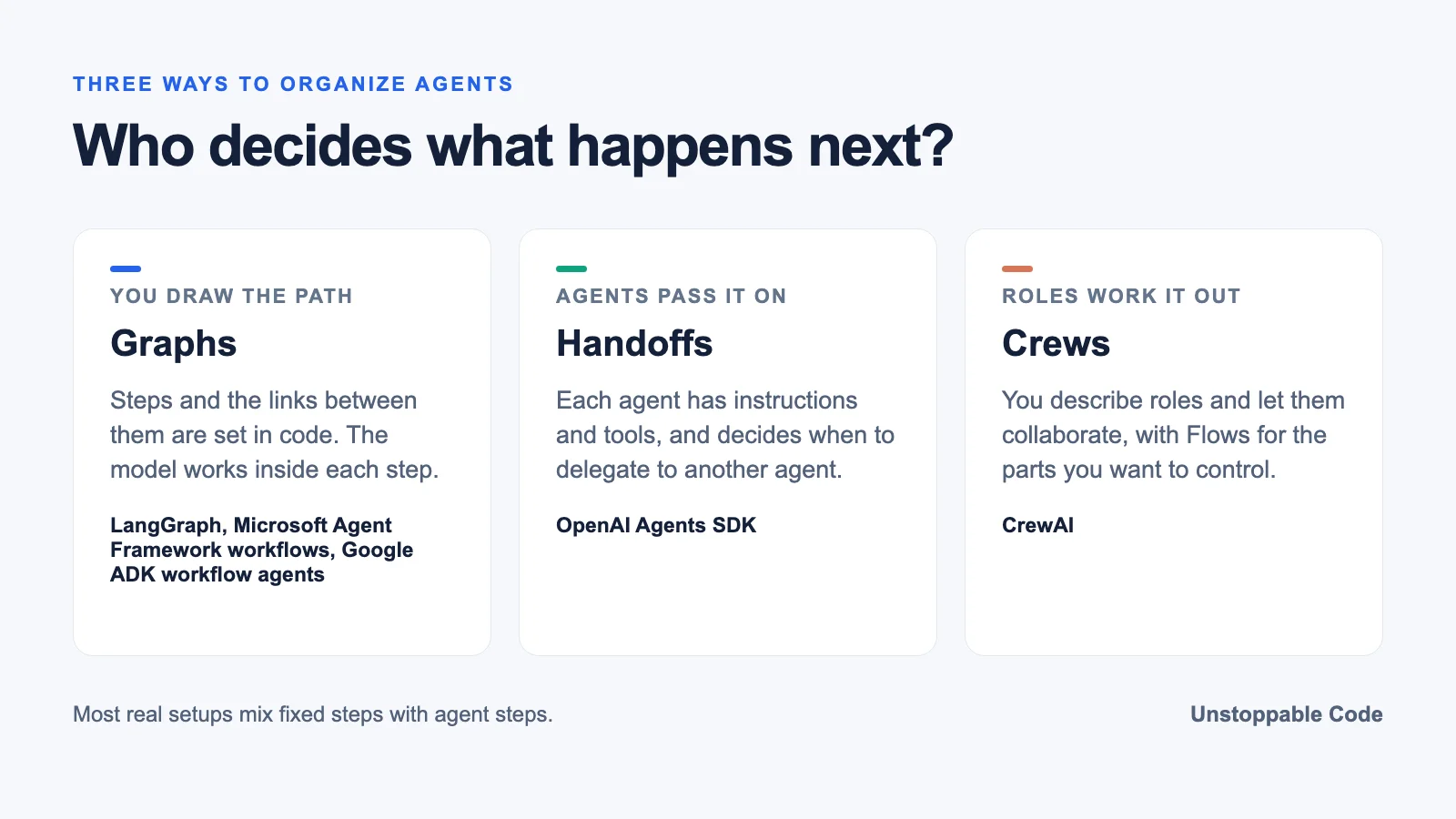
Every framework on the list has to answer the same question. Who decides what happens next? You or the model.
Graphs. LangGraph has you define workflows "as graphs of shared state, nodes, and edges," and it lets you "mix deterministic steps with LLM-driven steps in the same graph." Microsoft Agent Framework adds graph-based workflows on top of its agents. Google's ADK has workflow agents that run steps one after another or side by side. You draw the path and the model works inside each box.
Handoffs. The OpenAI Agents SDK keeps a very small set of primitives. There are agents with instructions and tools, handoffs that let one agent delegate to another, and guardrails that check inputs and outputs. The agents decide when to pass the work along.
Crews. CrewAI pairs Crews, which its docs call "teams of autonomous agents that collaborate," with Flows that manage state and control execution. You describe roles and let them work it out between them.
The hard part in any multi-agent setup is how agents share what they know. Our CEO Matt Gould has been working through exactly that in his own setups.
Right now I'm having agents hand prompts back and forth but I know a message board is a better design. I also have a separate check in system for one setup where they set up like a separate repo and check things into that like a library and review.
Handoffs pass the conversation. Graphs pass shared state. Matt's version checks work into a separate repo, which gives him a history he can review. And this question gets bigger every month, because the number of agents per person keeps going up.
I think in 12 months the typical employee will have 250-1000 agents running when they are active online and working... You are going to have agents managing agents.
Mixing models and plain code
The vendor SDKs are built around their own models, so the Claude Agent SDK runs Claude and the OpenAI Agents SDK is built around OpenAI's, though its docs include a multi-provider option. ADK is more open. Google's docs list Claude and OpenAI models next to Gemini, plus local models through Ollama.
That matters more than it sounds, because different steps want different models.
The pipeline is good at mixing models for different steps, and adding structured code steps mixed with agent steps.
The code steps are the part people skip. A typecheck or a test run doesn't need a model at all, because it either passes or fails, and a step like that is what keeps the agent steps honest between your reviews.
How to pick one
Start from the language your app is already in and the shape of the work.
- A long-running process you want to see and resume later: LangGraph. If your shop runs on .NET, Microsoft Agent Framework's graph workflows do the same job.
- Quick agents that pass work around: the OpenAI Agents SDK.
- Claude Code's agent inside your own product: the Claude Agent SDK.
- Roles: CrewAI.
- Java or Kotlin: Google's ADK.
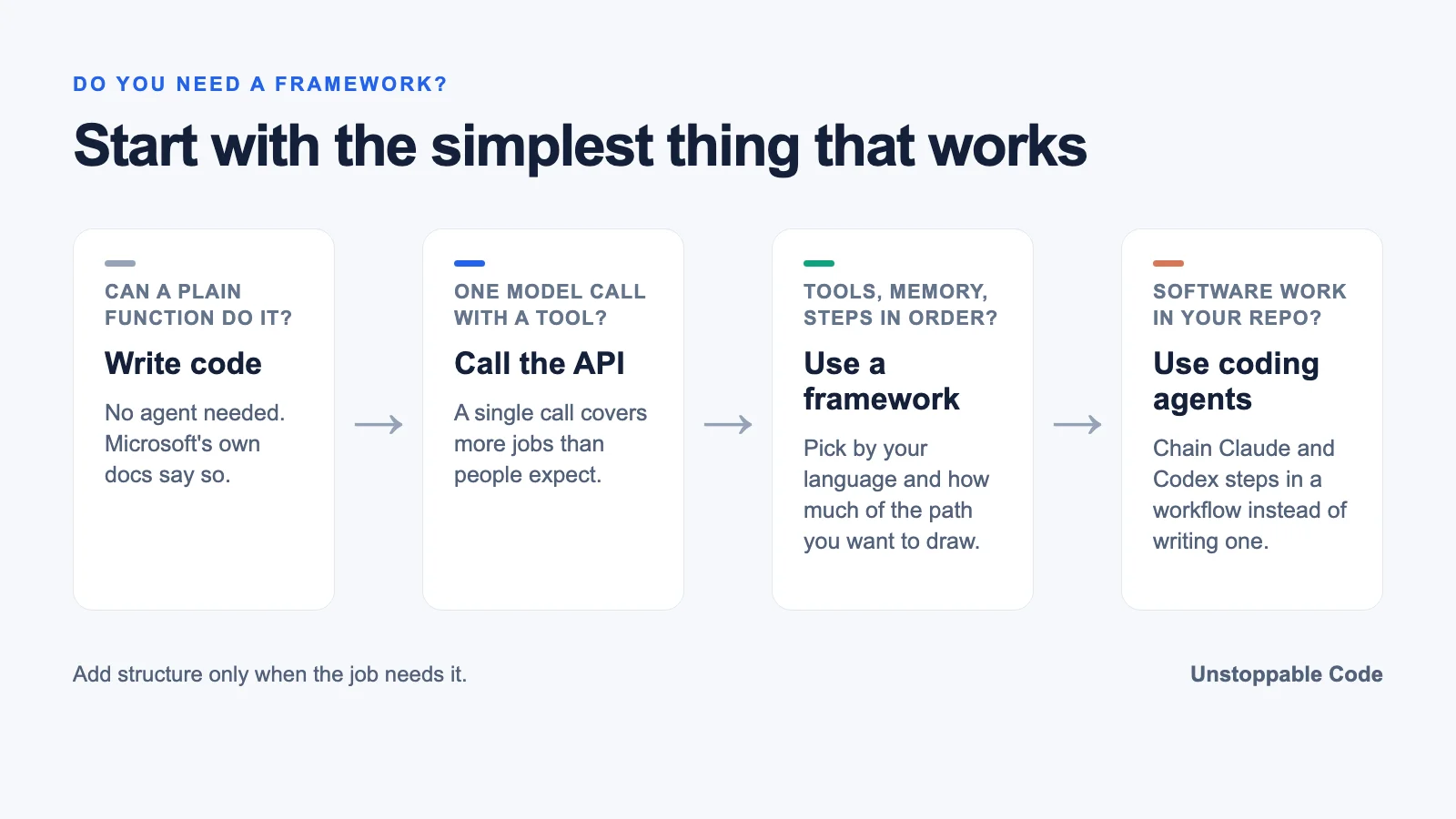
My own bias is toward structure, and I'll admit that's a preference.
It may not be for everyone, but I like having a structure to how my skill steps will work with each other and which models they will use defined.
When the agents are writing code
Most of these frameworks are for building an agent into your own product. If what you want to automate is software work in your own repo, you might not need to write one. In Unstoppable Code an On demand workflow is a YAML file of jobs and steps. Each step can be a Claude or Codex agent or a plain shell command, and the workflow can stop and wait for your approval. A Scheduled workflow runs it on a timetable. We used to call those pipelines and automations, which is how I still talk about them.
An automation is just a scheduled (or triggered) pipeline.
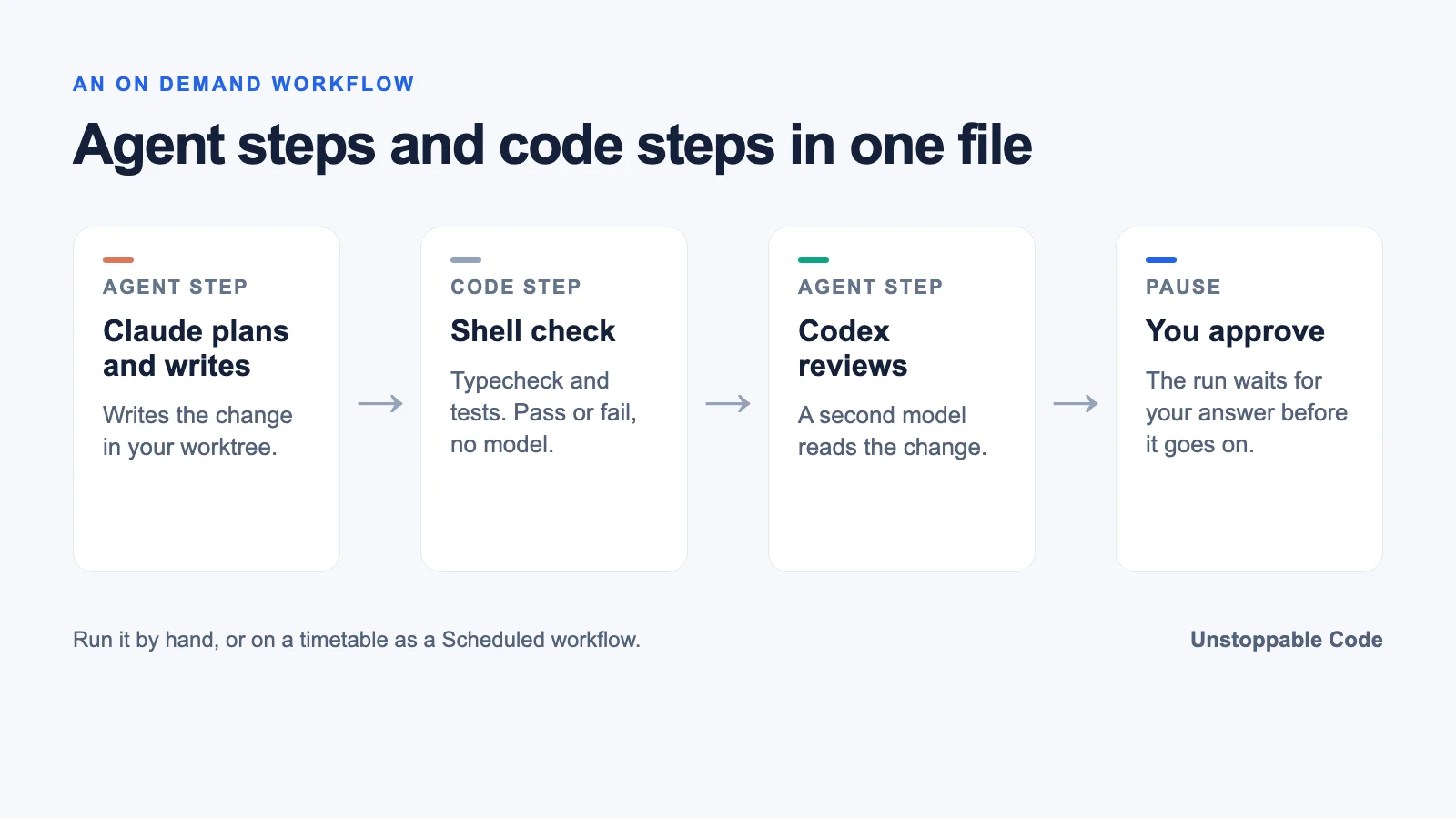
Once a workflow can reach the repo and the CI results, it can take the dull end of a release off your hands.
Frequently Asked Questions
What is an AI agent framework? An AI agent framework is a code library that runs the agent loop for you. It calls the model, runs the tools the model asks for, keeps state and passes work between agents, so you don't build that plumbing yourself.
What is the best AI agent framework in 2026? There's no single best one. LangGraph suits long-running stateful workflows and the OpenAI Agents SDK suits lightweight tool-using agents. The Claude Agent SDK brings Claude Code's agent into your own app. CrewAI is built for role-based teams of agents. Microsoft Agent Framework fits teams on .NET. Google's ADK is the one to look at if you write Java or Kotlin.
What is the difference between LangGraph and CrewAI? LangGraph has you define the workflow as a graph of state, nodes and edges, so you control each path. CrewAI has you define agents by role and group them into Crews, with Flows for the parts you want to control.
What happened to AutoGen and Semantic Kernel? Microsoft says its Agent Framework is the direct successor to both, built by the same teams. It combines AutoGen's agent abstractions with Semantic Kernel's enterprise features and adds graph-based workflows.
Do I need a framework to build an AI agent? Not always. If a plain function or a single model call with a tool can do the job, Microsoft's own guidance is to use that. A framework earns its place once the agent needs tools and memory, and the steps have to run in a set order.
Sources
- Agent SDK overview, Claude Code Docs, checked November 21, 2026.
- OpenAI Agents SDK, OpenAI, checked November 21, 2026.
- LangGraph overview, LangChain Docs, checked November 21, 2026.
- Agents on a leash: agentic AI remains mostly monitored at work, Stack Overflow Blog, May 27, 2026, checked November 21, 2026.
- Introduction, CrewAI Docs, checked November 21, 2026.
- Microsoft Agent Framework Overview, Microsoft Learn, checked November 21, 2026.
- The State of Development 2026: how engineers use AI agents today, Temporal, checked November 21, 2026.
- Agent Development Kit (ADK), Google, checked November 21, 2026.