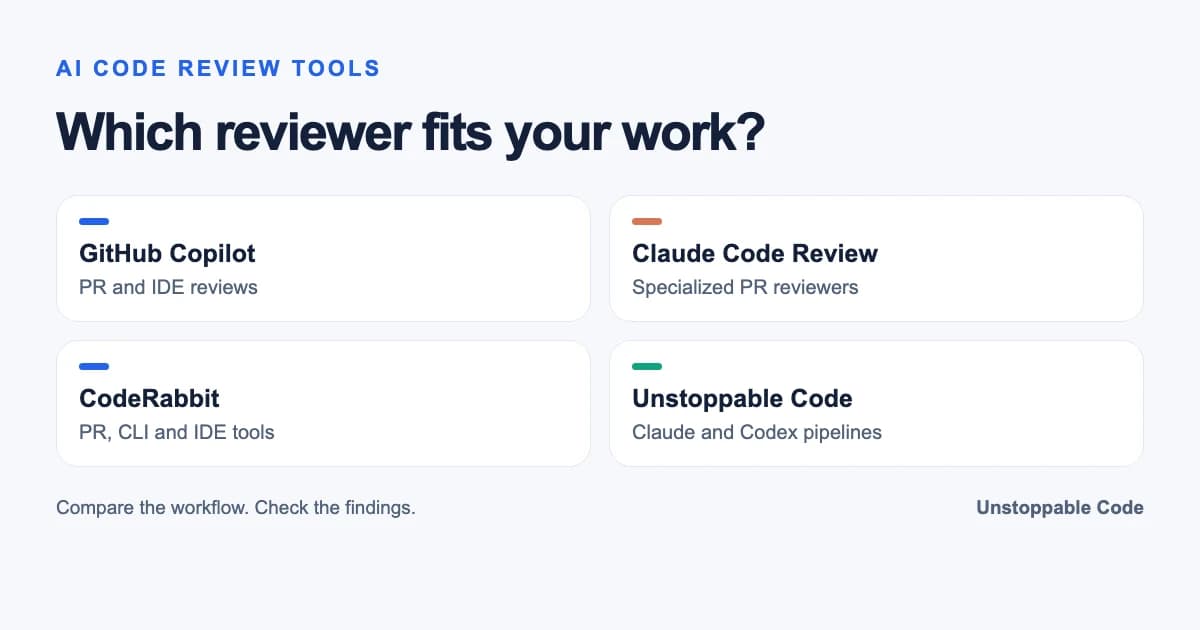

AI code review tools inspect code changes and suggest fixes; choose one by checking whether its findings hold up in your repository. A clean review still needs your judgment.
The Short Answer
| Tool | Where it reviews | How a review starts | Cost |
|---|---|---|---|
| GitHub Copilot code review | GitHub pull requests, plus VS Code, JetBrains, Visual Studio, Xcode and the GitHub CLI | When you assign Copilot, or on every PR if you turn that on | Paid Copilot plans only. GitHub estimates about $0.25 to $10 per review, depending on review depth |
| Claude Code Review | GitHub pull requests | When a PR opens, after every push, or when someone comments "@claude review" | Team and Enterprise plans. Billed separately by usage, about $15 to $25 per review on average |
| CodeRabbit | GitHub, GitLab, Bitbucket and Azure DevOps, plus a CLI and IDE extensions | Automatically on every PR and new commit, or on command | Per developer, from $24 a month billed yearly. Free for open source |
| Unstoppable Code | GitHub pull requests, from the desktop app | When you run a Claude, Codex or combined review pipeline | Runs on your own Claude or Codex account |
Copilot fits a team that already pays for Copilot, and it can hand its suggested fixes to Copilot's coding agent to open a new PR. Claude Code Review has the highest listed per-review cost of these tools. It posts findings as inline comments tagged by severity, and it never approves or blocks a PR. CodeRabbit covers the most code hosts and reviews every new commit by default. Unstoppable Code lets you run Claude and Codex reviewers on the same branch and compare what each one finds.
What makes an automated review useful?
Another reviewer gives the coding agent something concrete to address. I've used that loop:
right, as annoying as co-pilot review is....i do like having another AI auto review PRs, and then telling Claude to go address co-pilot's requests
The model behind the reviewer matters too. When we moved our automated reviews to newer Claude models earlier this year, the findings got noticeably better, especially from the smaller, faster model.
How to test a reviewer before you trust it
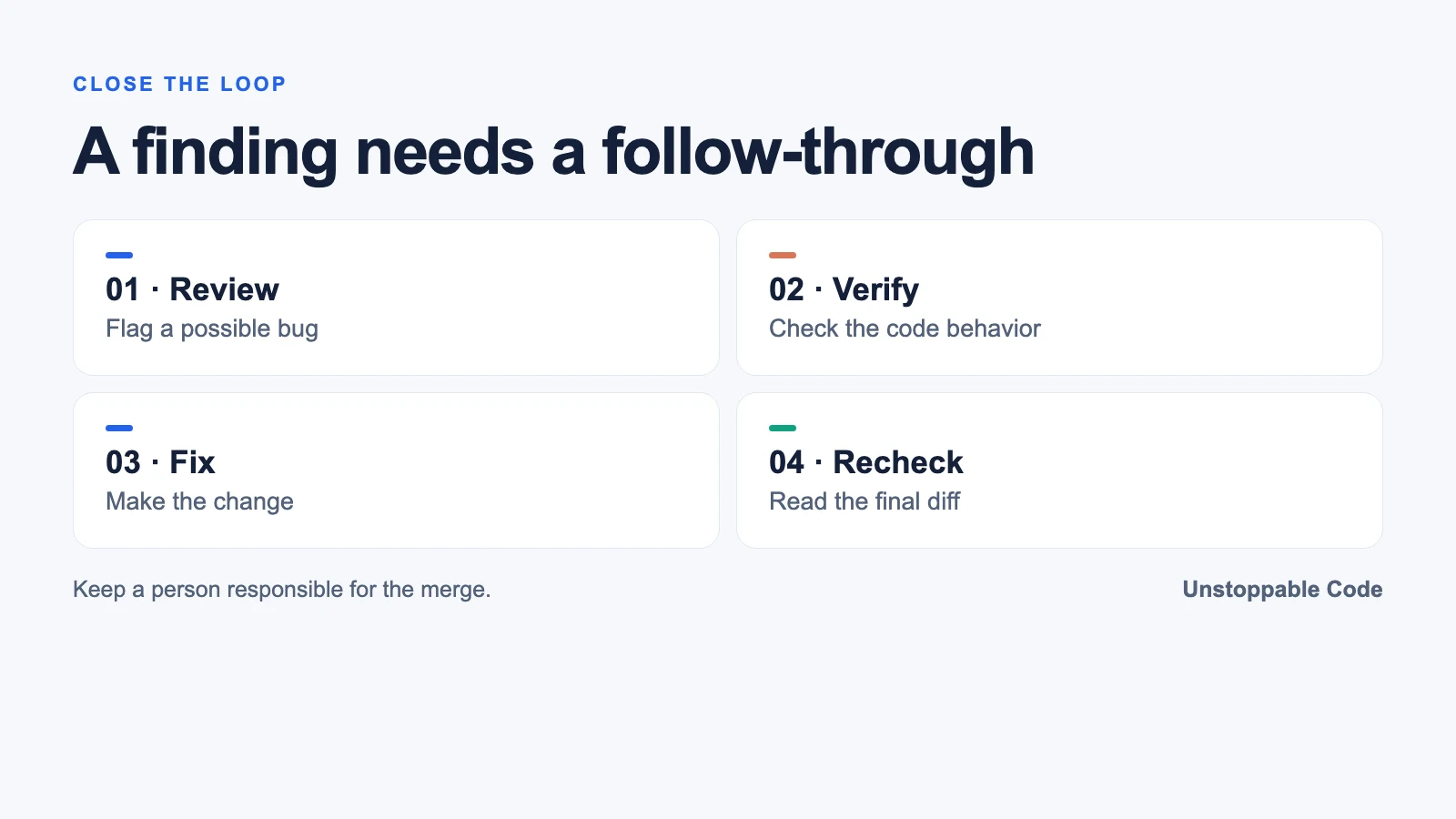
The quality gates guide covers automated checks like tests and linting. For reviewers, try the same small set of past PRs and record which comments reveal a reproducible bug, because someone has to spend time checking every plausible comment before deciding whether to change the code. Count false alarms and missed bugs too, and record whether its findings improved the PR.
Keep the person who merges in the loop
Unstoppable Code brings Claude and Codex review pipelines into the same app. The review walkthrough shows the findings landing on GitHub.
I've also tried letting agents carry patch work further:
OK it fixed merge conflicts, ran CI till green, gained approvals and merged 9 PRs. These were all patch-level PRs, as a proof of concept.
Small fixes like that are where letting an agent run further makes sense.
For the merge itself, my rule hasn't changed:
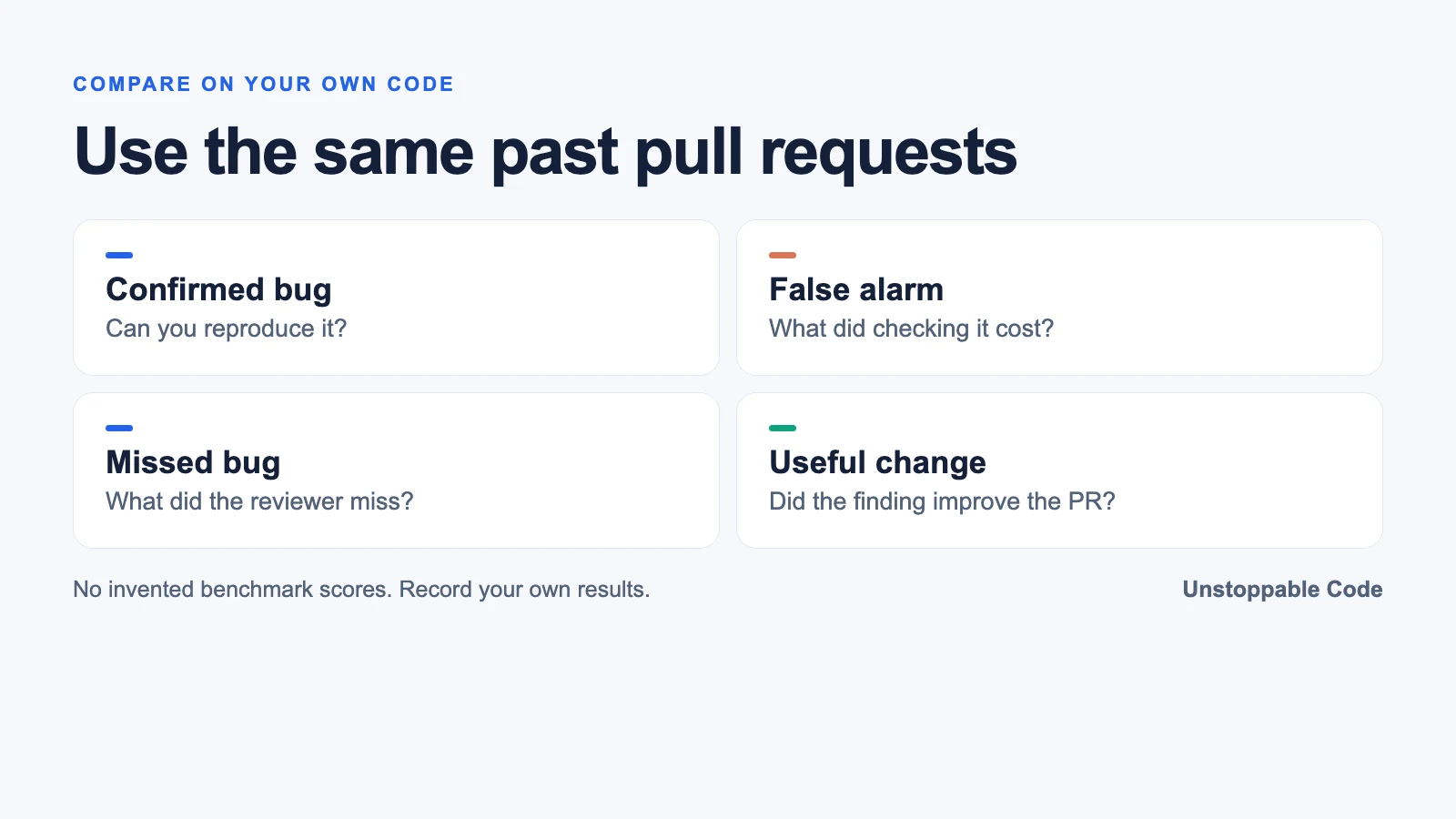
At the end of the day, you're responsible for what you merge so make sure you follow the guidelines
Frequently Asked Questions
Which AI code review tool is best? Start with your own PRs. If a reviewer finds real bugs but leaves you checking incorrect findings for hours, include that cost when you compare it with the other tools.
Does Claude Code Review use my included plan usage? No. Anthropic lists separate usage credits for its hosted Code Review service on Team and Enterprise plans.
Can an AI review replace tests? Keep both. A suggested bug and a failing test give you different evidence.
Sources
- GitHub Copilot code review, checked November 16, 2026.
- Anthropic Code Review setup and billing, checked November 16, 2026.
- CodeRabbit documentation, checked November 16, 2026.
- Plans and review limits, CodeRabbit docs, checked November 16, 2026.
- Supported platforms, CodeRabbit docs, checked November 16, 2026.