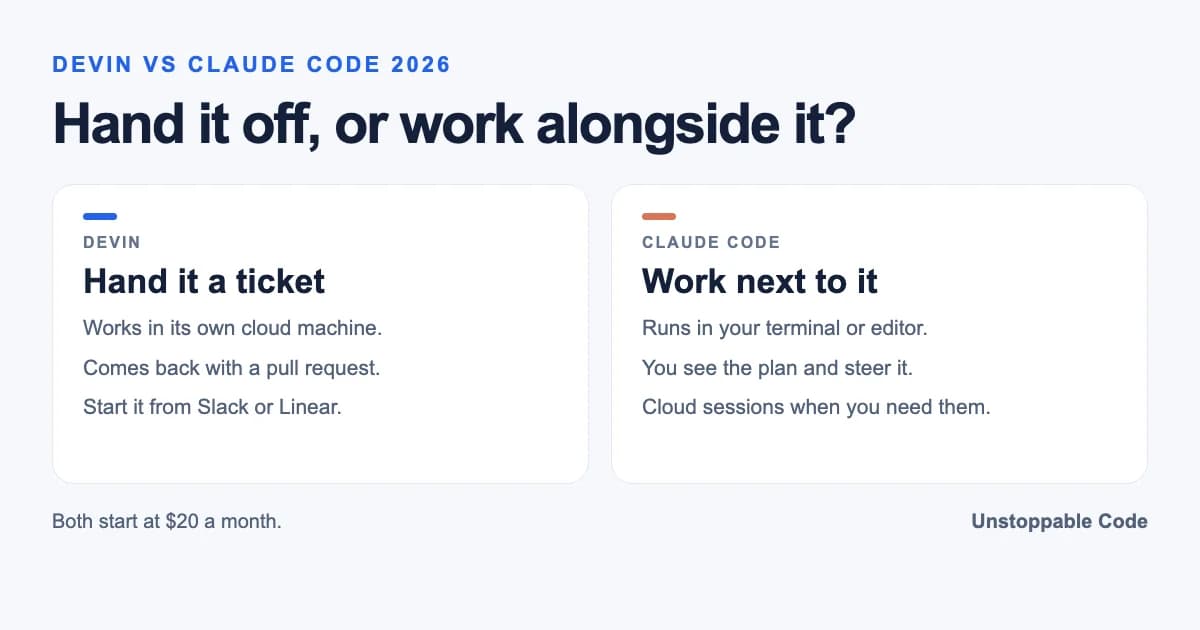

Devin vs Claude Code comes down to where the agent does the work: Devin takes a task and comes back with a pull request from its own cloud machine, and Claude Code works next to you in your terminal or editor. Pick Devin if you want to hand off whole tickets from Slack or Linear and review the PR later. Pick Claude Code if you'd rather steer the work while it happens.
The Short Answer
| Devin | Claude Code | |
|---|---|---|
| Made by | Cognition | Anthropic |
| Where it works by default | Devin Cloud, a VM with its own shell, browser and editor | Your terminal, editor or the Claude desktop app |
| How you start a task | Web app, Slack, Teams, Linear or Jira, or the Devin CLI | A prompt in your session, or claude --cloud |
| Hand work to the cloud | Yes, the core product (/handoff from the CLI) | Yes, cloud sessions on paid plans |
| Lowest paid plan | Pro, $20 a month | Pro, $20 a month ($17 billed yearly) |
| Top individual plan | Max, $200 a month | Ultra, $200 a month |
| Teams | From $80 a month, usage based | Team seats from $20 per seat a month (yearly) |
| Models | Several providers plus Cognition's own SWE-2 | Claude models |
| Best for | Scoped tickets you want back as a PR | Work you want to watch and steer |
Most teams aren't ready to let either one run alone yet. In a Stack Overflow pulse survey published in May 2026, 63% of technologists said they rarely or never let agents run entirely on autopilot.
How Devin and Claude Code work differently
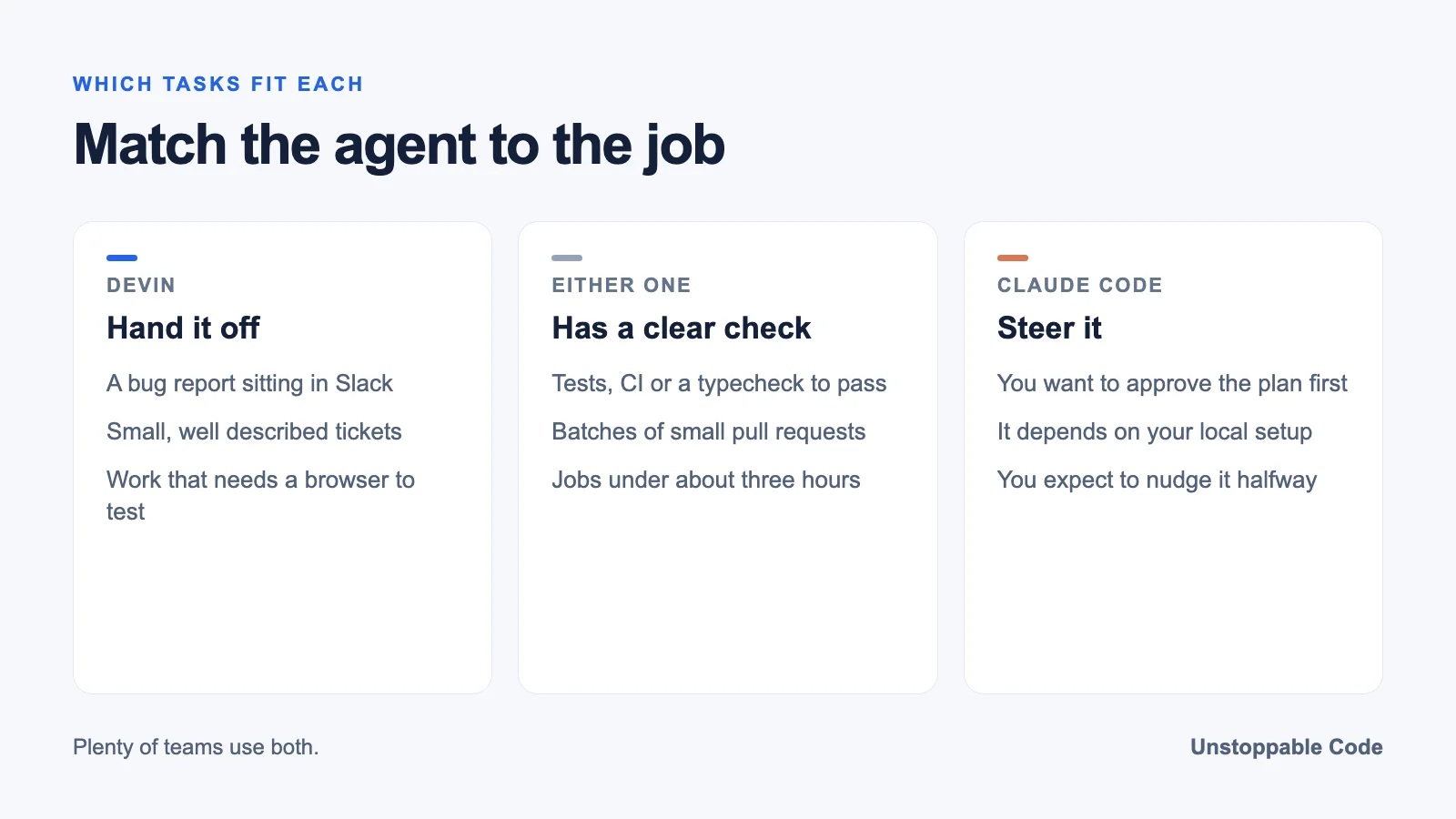
Devin was built for handing off. You tag it in a Slack thread or assign it a Linear ticket, and it opens a session on its own machine and works the ticket. You get a pull request back. Cognition's guidance is that if a task would take you three hours or less, Devin can most likely do it. Bigger jobs get split up.
Claude Code started on the other side. It runs in your repo on your laptop and you can see every file it touches. That sounds like more work for you. In my experience it's been the opposite.
This is definitely a big improvement from my experience in Cursor agents. While good, I've found they require a lot more babysitting and personal interaction to keep the agent moving in the right direction. Key difference for me here is that Claude Code was very hands off and it iterated by itself until finding a solution.
They've been moving toward each other
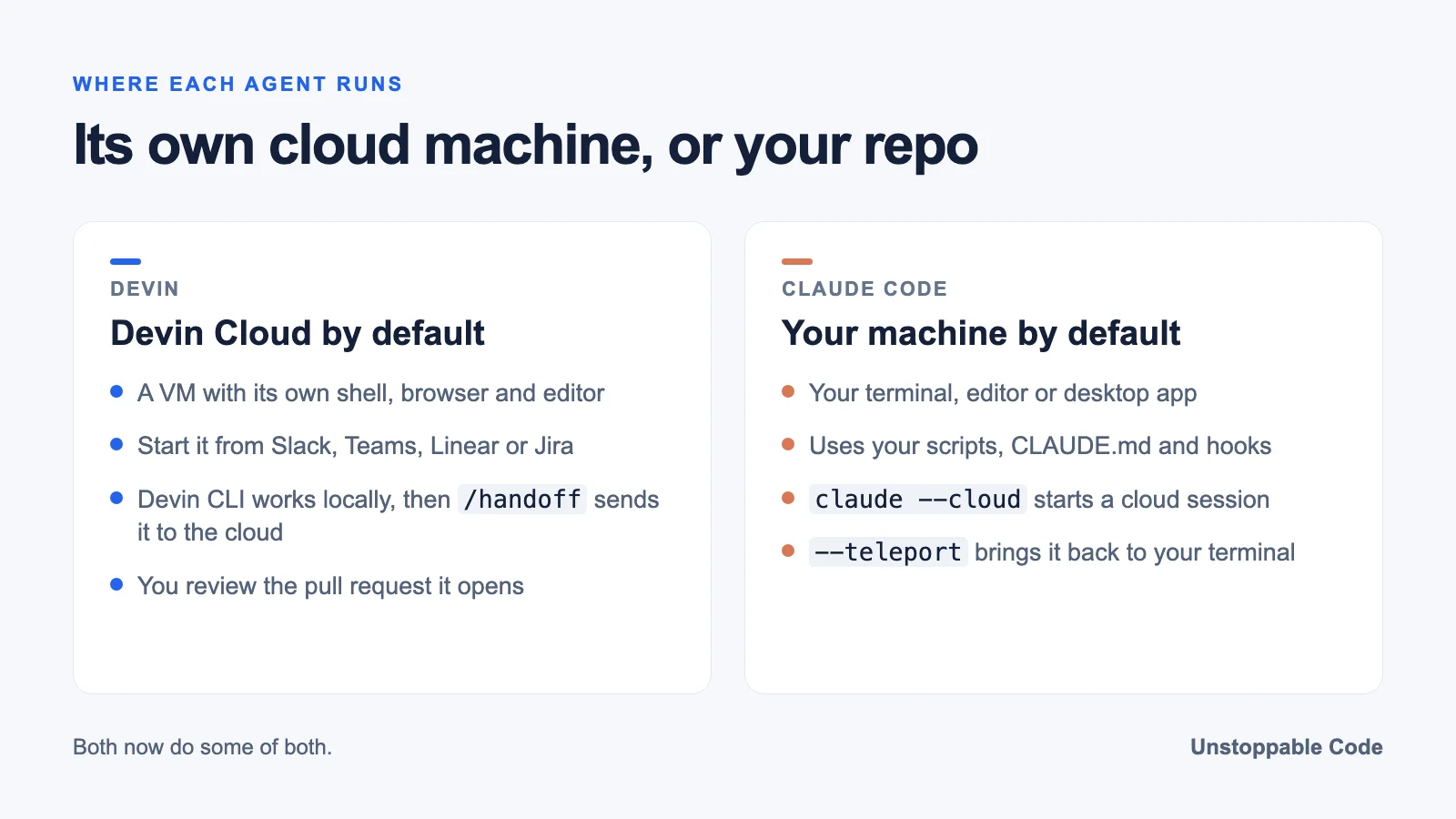
The gap is smaller now. Cognition shipped the Devin CLI in April 2026, a local agent in your terminal that can pass a session to the cloud with /handoff. In June it renamed Windsurf to Devin Desktop and made the Agent Command Center the main screen. The announcement says "the work of software engineers is shifting towards agent management."
Anthropic went the other way. claude --cloud starts a session on Anthropic's machines that keeps going after you close your laptop, and --teleport pulls it back into your terminal. You can start several at once and check on them from the Claude mobile app, and they all count toward your plan's usage with no separate charge for the VM.
So either tool can now take a whole job. I gave an agent a stack of small pull requests to see how far it would go.
OK it fixed merge conflicts, ran CI till green, gained approvals and merged 9 PRs. These were all patch-level PRs, as a proof of concept.
That only worked because there was CI to run against. Devin's own docs make the same point: tasks with clear success criteria, like tests or CI checks, get the best results. You don't need a giant suite for that either. Keep a few golden tests, typecheck, lint, that's it.
Where Devin is stronger
Devin's best trick is that it lives where requests already show up. A bug report in Slack can turn into a pull request without anyone opening an editor. Each session also gets a full desktop with a browser, so it can click through your app and take screenshots before it opens the PR. Cognition also sells Devin Review for pull requests and DeepWiki for searchable docs on your repos, and Automations can start sessions on a schedule. The Teams plan adds shared sessions.
It also isn't tied to one model company. Cognition's pricing page lists frontier models from several providers on Pro, Claude included, plus its own SWE-2. If your team wants to switch models per task without switching tools, that's a real plus.
Where Claude Code is stronger
Claude Code is the better fit when you want to be in the loop. It runs your own scripts and follows your CLAUDE.md and hooks, so the agent works the way your repo already works. Plan mode lets you approve the approach before any file changes. And when the plan is right, it often gets there on the first try.
The API key management UX is one-shot from Claude Code. First attempt at anything UI related, did a nice job and also created the authenticated backend CRUD + DB entity.
Connecting it to other services is quick too, because MCP servers can sign in with OAuth.
OAuth is a game changer, my account connection to Unstoppable Domains got picked up by my Claude Code terminal as well. One OAuth persisted across every device / session.
Cost is the other reason. Claude Code comes with Claude's paid plans, so a lot of developers already pay for it. More on that in what your Claude Code subscription includes.
How the pricing compares
Both start at $20 a month for an individual and top out at $200. Devin's paid plans come with a usage allowance that refreshes daily and weekly, and anything past it is billed at API prices. In April 2026 Cognition dropped its old $500 Team plan, and it started charging for tools that used to be free, like Devin Review. Claude Code usage shares one limit with the rest of your Claude account, and Max is 5x Pro usage at $100 a month. We cover Devin's plans in more detail in is Devin AI worth it.
Which one should you pick?
If most of your backlog is small, well described tickets and your team lives in Slack, try Devin. If you're a developer who wants to read the plan and nudge the agent halfway through, use Claude Code. Plenty of teams will end up with both. That's fine.
My colleague Matt Gould thinks the number of agents per person is about to go way up.
I think in 12 months the typical employee will have 250-1000 agents running when they are active online and working... You are going to have agents managing agents.
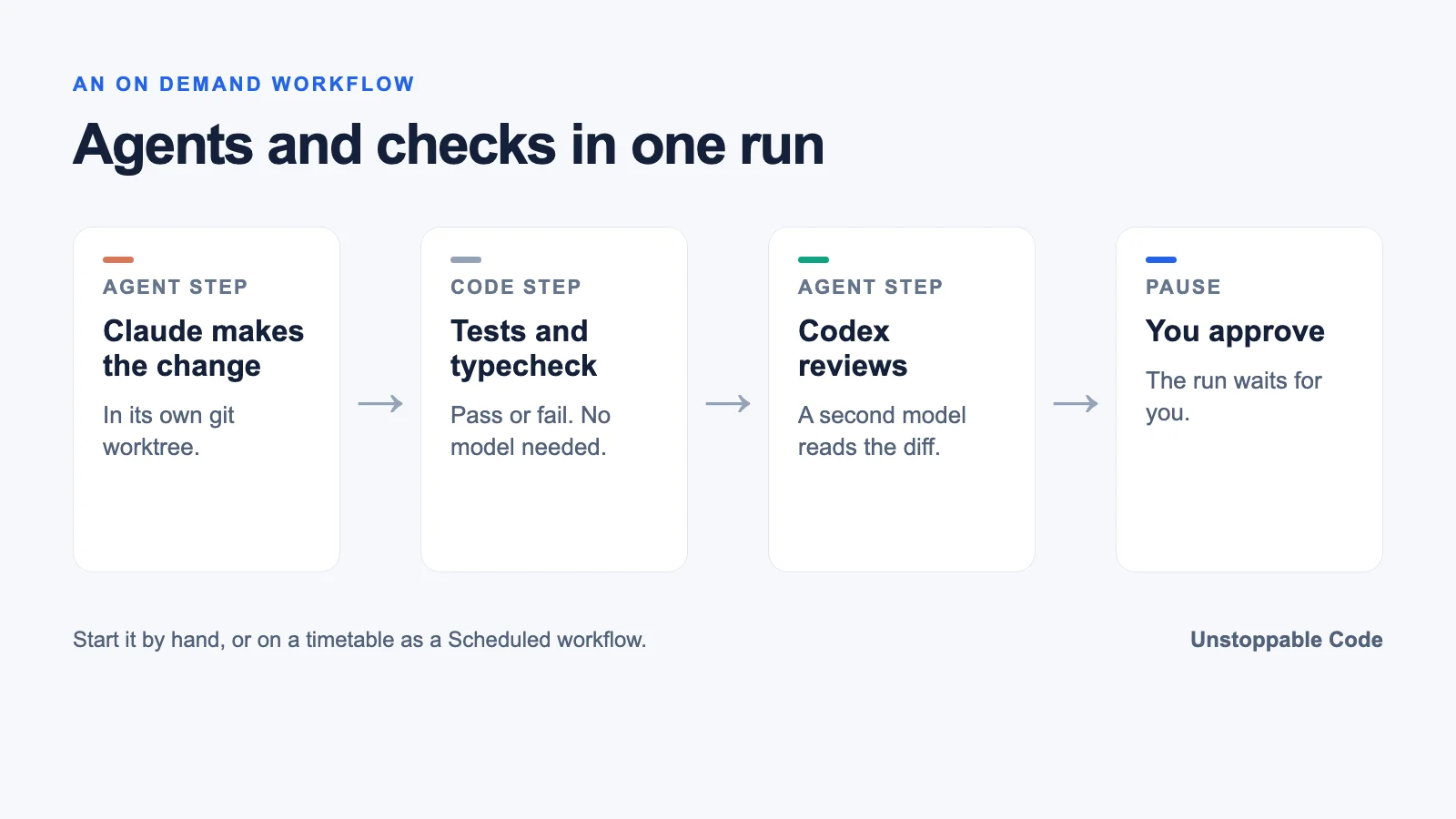
At that point you need a way to keep agents apart and put repeat jobs on rails. I run Claude Code inside Unstoppable Code, where each chat gets its own git worktree, and repeat jobs become On demand workflows that a Scheduled workflow can start. We used to call those pipelines and automations.
The pipeline is good at mixing models for different steps, and adding structured code steps mixed with agent steps.
Frequently Asked Questions
What is the difference between Devin and Claude Code? Devin is Cognition's AI software engineer that takes a task and returns a pull request from its own cloud machine. Claude Code is Anthropic's coding agent that works in your terminal or editor while you watch, with optional cloud sessions for longer jobs.
Is Devin better than Claude Code? Neither is better for every job. Devin fits scoped tickets you want to hand off from Slack or Linear. Claude Code fits work you want to plan, steer and review as it happens.
How much does Devin cost compared to Claude Code? Both start at $20 a month for one person and go up to $200 a month. Devin Teams starts at $80 a month and is usage based. Claude Code is included in Claude's paid plans.
Can Claude Code run in the cloud like Devin? Yes. Running claude --cloud starts a session on Anthropic's machines that keeps going after you close your laptop, and claude --teleport brings it back to your terminal. Cloud sessions come with Pro and higher plans.
Does Devin use Claude models? Devin's Pro plan lists frontier models from several providers, including Anthropic's Claude, along with Cognition's own SWE-2 model.
Sources
- Plans and Pricing, Devin, checked November 23, 2026.
- New self-serve plans for Devin, Cognition, April 14, 2026, checked November 23, 2026.
- Introducing Devin Desktop, Cognition, June 2, 2026, checked November 23, 2026.
- When to Use Devin, Devin Docs, checked November 23, 2026.
- Hand off to cloud Devins, Devin Docs, checked November 23, 2026.
- Claude Code on the web, Claude Code Docs, checked November 23, 2026.
- Pricing, Claude, checked November 23, 2026.
- Agents on a leash: agentic AI remains mostly monitored at work, Stack Overflow Blog, May 27, 2026, checked November 23, 2026.