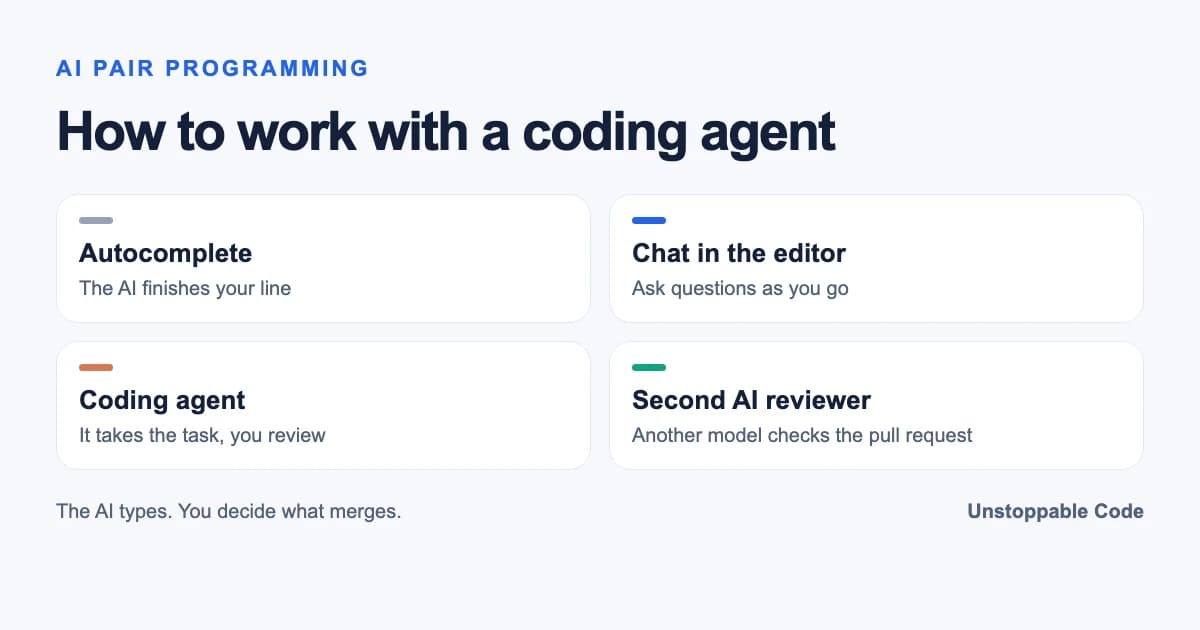

AI pair programming means writing code with an AI model as your partner, where the model suggests or writes the code and you steer and review it. It ranges from autocomplete in your editor to a coding agent that works through a whole task while you check the result.
The Short Answer
| Style | Who's typing | Good for | Watch out for |
|---|---|---|---|
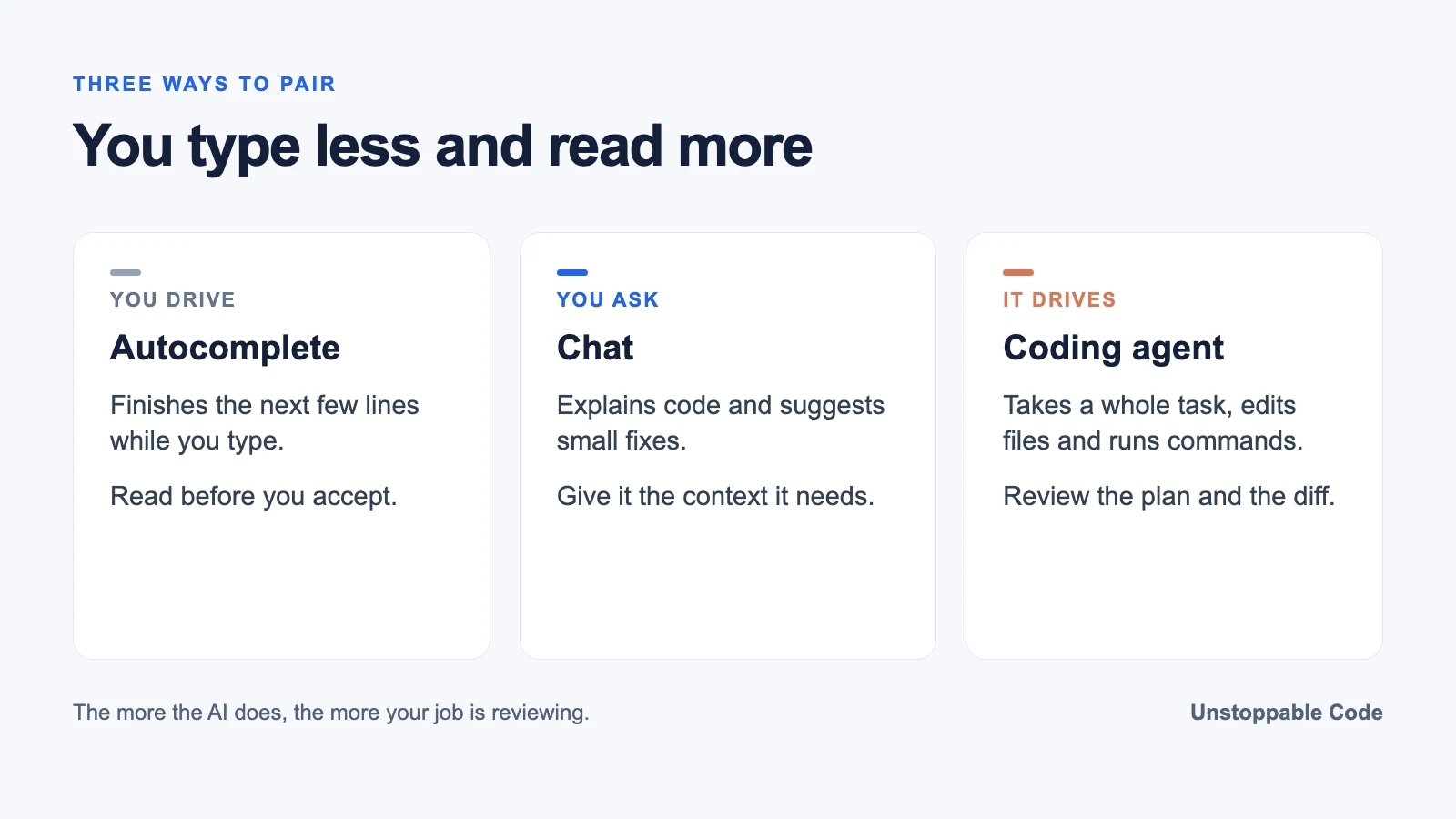
| Autocomplete (GitHub Copilot suggestions) | You, with the AI finishing lines | Boilerplate and the next few lines | Accepting suggestions you didn't read |
| Chat in the editor | You, asking as you go | Explaining code and small fixes | Pasting answers in without context |
| Coding agent (Claude Code, Codex, Cursor agents) | The agent, with you reviewing | Whole tasks across many files | Big diffs that take a while to check |
| A second AI as reviewer | Another model, on your pull request | Catching what the first model missed | Comments you still have to triage |
GitHub has called Copilot "your AI pair programmer." Thoughtworks pushes back on that framing in its Technology Radar, saying a coding assistant can bring some of the benefits of pairing while advising against fully replacing pair programming with AI. Both are fair. The AI pairs well on the code and a person still owns the decisions.
From autocomplete to an agent that drives
Most people started with autocomplete. You type and it guesses the next line. The bigger change came when agents started taking a whole task and working through it on their own. Claude Code was the first one that did that for me.
This is definitely a big improvement from my experience in Cursor agents. While good, I've found they require a lot more babysitting and personal interaction to keep the agent moving in the right direction. Key difference for me here is that Claude Code was very hands off and it iterated by itself until finding a solution.
Sometimes the first try is good enough to keep.
The API key management UX is one-shot from Claude Code. First attempt at anything UI related, did a nice job and also created the authenticated backend CRUD + DB entity.
That changes your half of the pair. You type less and you read a lot more.
Give it the context a person would need
A human pair can lean over and ask what you meant. An agent only knows what you hand it. I learned that while writing a reply to some feedback we got from ICANN, which isn't code but works the same way.
I found Claude to be really good at drafting and structuring the response. My input format: 1. Original question text from handbook. 2. Our original answer. 3. The feedback received from ICANN. 4. Rambling thoughts/notes about what I want in the response.
I hand over a bug fix the same way, with the original and my rough notes on what I actually want.
Standing instructions help too, up to a point. A skill is at the end of the day a pile of prose that you hope the agent follows.
Let a second AI review the work
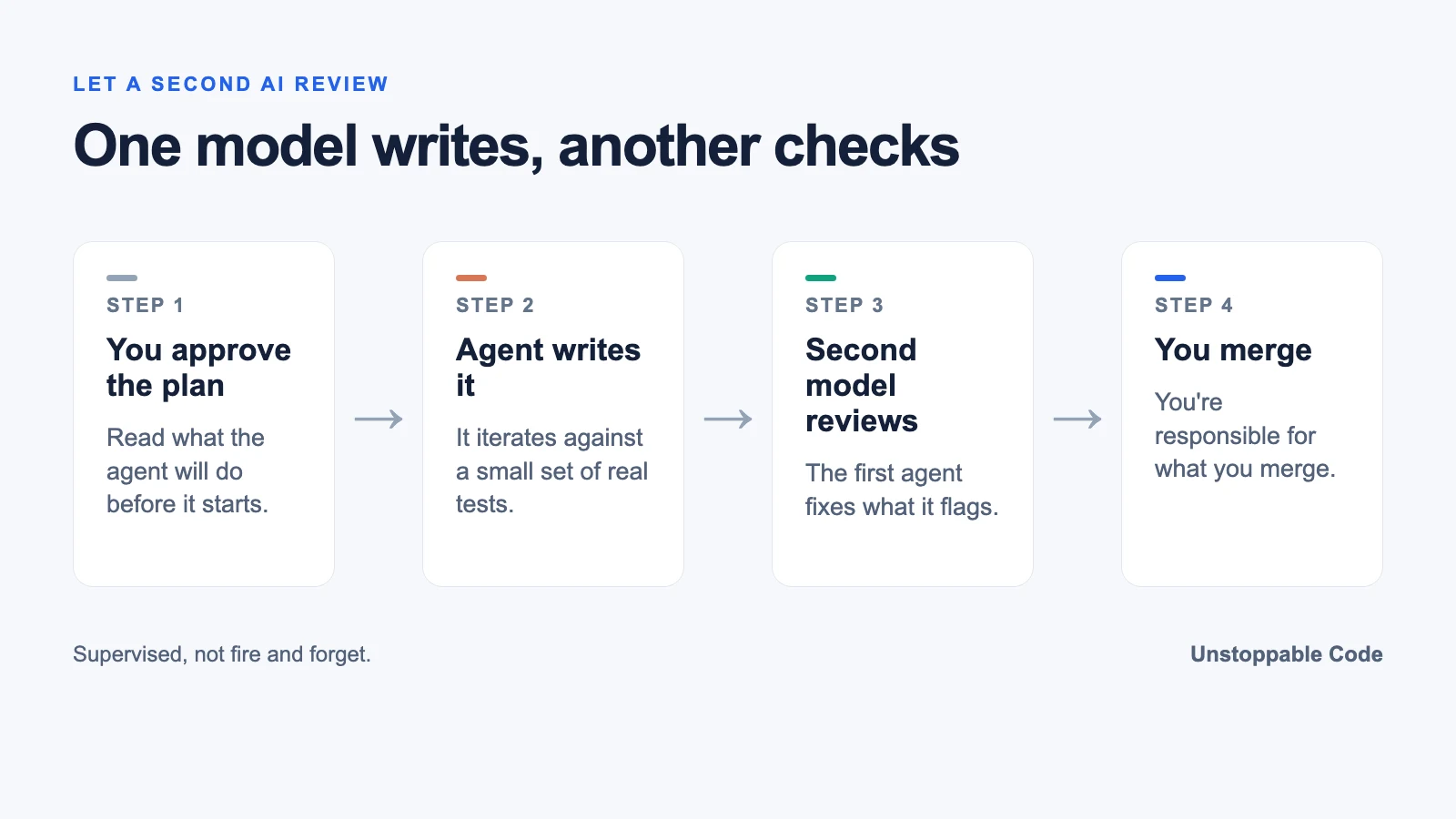
The part I've come around on is having one model check another.
As annoying as Copilot review is, I do like having another AI auto review PRs and then telling Claude to go address Copilot's requests.
Which model does the reviewing matters more than you'd think. We saw it back in February, when our automated reviews moved up a model generation.
Automated AI reviews are now upgraded to Opus 4.6 + Sonnet 4.6, and the quality is noticeably better especially for Sonnet.
You can set this up yourself with any two models. Our own walkthrough on how to review a branch with Claude and Codex before you merge shows one way.
Keep the checks small and real
An agent that keeps iterating until it finds a solution needs something real to check its work against, and for us that's the test suite. We had way too many.
Our repo has ~3.4M lines of product code and ~5.7M lines of test code. I'm cutting that down from ~10,900 test files to a registered keep-list of ~235 "golden" tests. Most of that 5.7M pins implementation details instead of real product flows. That costs us: slow, expensive CI. Flaky tests that fail at random, force reruns and teach everyone to ignore red builds. Brittle tests that break on harmless refactors. Longer dev cycles.
What's left fits in one line. Keep a few golden tests, typecheck, lint, that's it.
An agent still reruns that suite over and over while it works, but that costs machine time and not yours. It's fine, would have been annoying in the old days. But the robots don't care about wasted cycles.
Your own time is different. In a July 2025 study by METR, experienced open source developers using early 2025 AI tools took 19% longer on tasks in their own repositories, even though they expected to be faster. Reading and fixing the AI's work is real time. At the end of the day, you're responsible for what you merge.
Where a human pair still wins
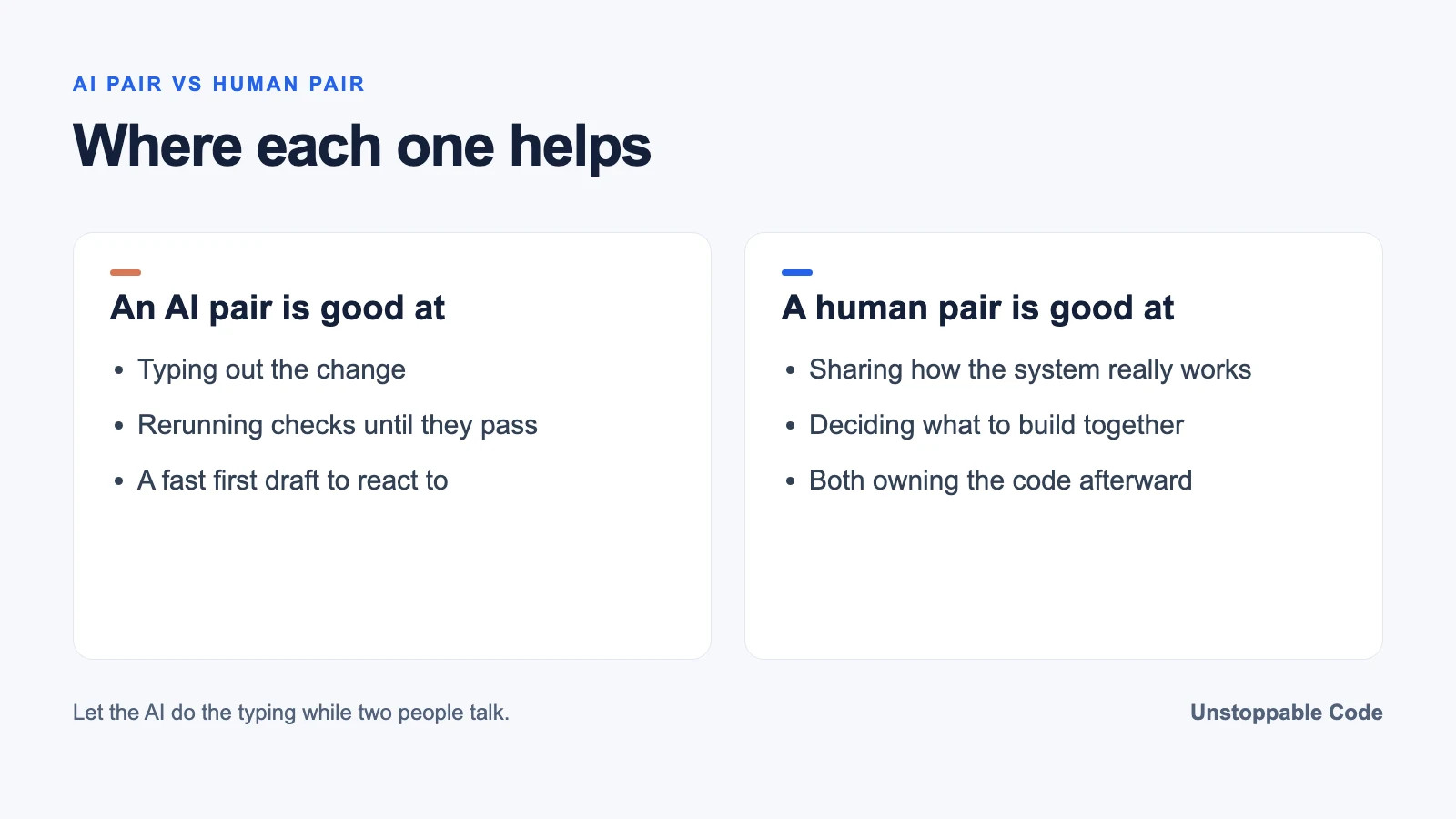
Birgitta Böckeler made this case on Martin Fowler's site back in 2023. Her point was that coding assistants cover only a small part of what pairing is for, because pairing helps the whole team and not just one coder. Two people who pair on a system both understand it afterward. An AI pair leaves only you knowing what changed.
So if two people need to own a piece of code, they should still sit together on it sometimes. The AI can do the typing while they talk.
It isn't only developers anymore
The other thing that surprised me is who's pairing with AI now.
I went to the chiropractor yesterday because of all of this backbreaking AI work that we do. Small talk with the chiropractor, turns out that he is building his own customer management system because he doesn't want to pay $15,000 a year for the one he's currently using. He's mostly coding by hand and using ChatGPT for help. Of course I tell him about our product, he sounds interested. His first question, do you have a Linux version? Let me just reiterate. My chiropractor is using AI to build his own customer management portal, and uses Linux. What world do we live in?
Not everyone gets to work like that, though.
There's burying heads in sand, and then also leadership not giving their orgs the freedom to use the tools. When I had a lunch catch up with my old boss from IBM, he was extremely frustrated about not being able to use modern AI tools due to cost and availability. Very grateful we're able to innovate freely.
How I pair with agents in Unstoppable Code
My own setup is simple. In Unstoppable Code I review the agent's plan before it writes anything and steer it while it works when it drifts. Then a second model reviews the branch before I merge. Most of the time I probably could have merged what the agent handed me straight away. I didn't want to yolo it.
Frequently Asked Questions
What is AI pair programming? Writing code with an AI model as your partner. The model suggests or writes code and you steer, review and decide what ships.
Can AI replace a human pair programmer? Not fully. Thoughtworks advises against replacing pair programming with AI because pairing also spreads knowledge across a team.
What's the difference between an AI coding assistant and a coding agent? An assistant suggests code while you type. An agent such as Claude Code takes a task, edits files and runs commands until it reaches a result for you to review.
Does AI pair programming make developers faster? It depends on the work. METR found experienced developers took 19% longer with early 2025 AI tools on their own mature repositories, so measure it on your own tasks.
How do I review code from an AI pair programmer? Read the plan before it starts, keep a small set of real tests it has to pass and have a second model review the pull request before a person merges it.
Sources
- Replacing pair programming with AI, Thoughtworks Technology Radar, April 2025 edition, checked November 18, 2026.
- Coding assistants do not replace pair programming, Birgitta Böckeler on martinfowler.com, August 10, 2023, checked November 18, 2026.
- Measuring the Impact of Early-2025 AI on Experienced Open-Source Developer Productivity, METR, July 10, 2025, checked November 18, 2026.
- What is GitHub Copilot?, GitHub Docs, checked November 18, 2026.
- Claude Code overview, Anthropic, checked November 18, 2026.